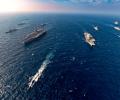
China's behaviour in the post-pandemic geopolitical landscape which may determine the Quad's future trajectory, notes former foreign secretary Shyam Saran.

Hailing India for keeping "neutral stand" over the South China Sea issue despite pressure from the US and Japan, state-run Chinese media on Wednesday said there are some contradictions and frictions between the two nations but the overall bilateral relations have been developing smoothly.

MH-60 Romeo Seahawks would add lethal capabilities of the Indian Navy, which experts say is the need of the hour given the aggressive behavior of China in the Indian Ocean region.
It also took exception to Australian Foreign Minister Julie Bishop's call for resolving the Doklam issue peacefully

Modi will have a number of high-profile multilateral and bilateral meetings with global leaders including United States Vice President Mike Pence and Singapore premier Lee Hsein Loong.
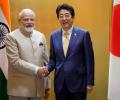
With the signing of the pact, the Quad grouping of India, Japan, Australia and the US is set to gain more heft now, notes Dr Rajaram Panda.
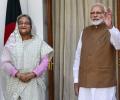
The pacts signed after Modi-Hasina talks provided for deeper cooperation between the two countries in areas of water resources, youth affairs, culture, education and coastal surveillance.

'Despite the current tension at Doklam and the risk of escalation on the Himalayan land frontier, it is the Indian Ocean we need to worry about more,' says Nitin Pai.

Modi said India will continue its support to ASEAN for a rules-based security architecture for the region.

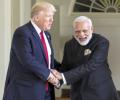
Announcing the visit from June 25, the external affairs ministry on Monday said the Modi-Trump discussions will provide a new direction for deeper bilateral engagement.

China will increase its defence spending by "around seven per cent" this year, as it vowed to guard against "outside meddling" in its territorial disputes.

An agreement to expedite the Jaitapur nuclear plant was expected to be signed.
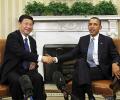
Obama says China shouldn't be threatened by good Indo-US ties.

There's still little indication of forward movement in Indo-US defence relations.
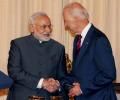
Prime Minister Modi needs to call Biden next month and clearly say: 'Mr President, the threat from China is clear and present. We, in New Delhi, have determined it to be an urgent national priority to outfit our submarines and aircraft carriers with nuclear propulsion and we want to cooperate with America on this programme",' advises Ajai Shukla.
'The world does not care about the tension on our border.' 'India has to emerge as a strong economic power.' 'Respect comes when the world sees a country with a direction and leadership that has a vision,' points out Ramesh Menon.

The two countries also decided to expand trade and commercial ties holding that there are opportunities to exploit untapped economic potential in the two countries.

Prime Minister Narendra Modi and Sri Lankan President Maithripala Sirisena on Monday held talks at Hyderabad House

During his visit, first by an Indian prime minister in 34 years, Modi will seek to enhance cooperation in energy and trade and reach out to investors to hardsell India as an attractive business destination.

New Delhi remains a priggish suitor to Washington's overtures, but it has begun appreciating potential tech benefits to ties with the US.

'By the time he came out after nearly five hours, he had a one-to-one conversation with the President, a delegation-level meeting, a reception, a dinner, a tour of the White House and a joint statement of a kind none of his predecessors ever had,' says Ambassador T P Sreenivasan.
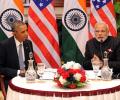
India has moved beyond the traditional trappings of non-alignment

Narendra Modi had stressed need for shifting focus from port development to 'port-led development' model to maximise gains
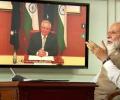
The Mutual Logistics Support Agreement will allow militaries of the two countries to use each other's bases for repair and replenishment of supplies besides facilitating scaling up of overall defence cooperation.
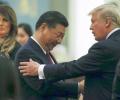
'While many Chinese policy makers dismiss the political, economic and technological component of US-India relations, they express caution on the defence-related ties which also happens to be a major driver in US-India relations,' explains China expert Srikanth Kondapalli.

'Lingering border disputes and fierce geostrategic competition in South Asia between China and India are likely to temper any cooperation Beijing might hope to achieve with New Delhi in the SCO,' says P K Vasudeva.

'India appears to have stood its ground on strategic autonomy by resisting US pressure on Russia, China and Iran, but succumbed to the temptation to walk into a tighter embrace in defence cooperation, a high priority of the Trump administration,' notes Ambassador T P Sreenivasan.
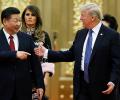
'What matters is that India's perspective on global issues -- climate change, intellectual property, free trade, trade routes being kept free, digital technology -- are listened to with respect,' says Ambassador B S Prakash.

India is no longer shying away from playing a role on the regional and international stages and is willing to don a bigger role in regional politics. It is showing traits of a responsible stakeholder in the regional security dynamics, says Dr Rahul Mishra.

External Affairs Minister Sushma Swaraj on a two-day visit during which she is expected to discuss the fishermen's issue and rights of minority Tamils with the Lankan leadership.

India and China on Friday signed a record 24 agreements in key sectors

Under the 'Major Defence Partner' recognition, the US will continue to work toward facilitating technology sharing with India to a level commensurate with that of its closest allies and partners.

Both have been robustly muscular leaders who began as immensely charismatic politicians conveying an impression that they were makers of history, raring to go. Both have been hyperactive on the world stage. But in the final analysis, Abe is departing on a sombre note, unceremoniously and apologetically, observes Ambassador M K Bhadrakumar.

"A Maputo morning, an African dawn! PM @narendramodi arrives in Mozambique for the first leg of his visit," Ministry of External Affairs spokesperson Vikas Swarup tweeted on Modi's arrival in Mozambique's capital Maputo.
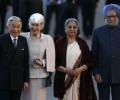
In recent years India-Japan relations have acquired rich economic content and strategic intents. Although the bilateral trade at $18 billion between the two countries is not very impressive and leaves much to be desired, the economic engagement between the two countries is both qualitatively and quantitatively noteworthy. India-Japan defence cooperation, however, has generated a lot interest among the strategic community in the context of rise of China. There has been a lot of speculation about India-Japan strategic partnership to hedge China, says Rup Narayan Das.

General Mattis has been the most steadfast champion in Trump's cabinet of the US-India defence relationship. If Trump chooses a more pliable successor, the Pentagon's attention could go off India.

He also emphasised that those giving shelter to terrorists and using them as political instruments must be condemned, an apparent reference to Pakistan.

During the phone call, Trump underscored the determination of the US to defend itself and its allies from the growing threat posed by the North Korean regime, the White House said.
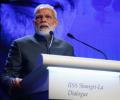
"No other relationship of India has as many layers as our relations with China. We are the world's two most populous countries and among the fastest growing major economies. Our cooperation is expanding," he said.

'This is the first time that the Americans have agreed to refer to "cross-border terrorist attacks" in a joint statement.' 'No wonder Pakistan has called the joint statement "singularly unhelpful" and has blasted it, and its all-weather friend China has applauded Pakistan's frontline role in combating terrorism,' points out former foreign secretary Ambassador Kanwal Sibal.
